ADVERTISEMENT
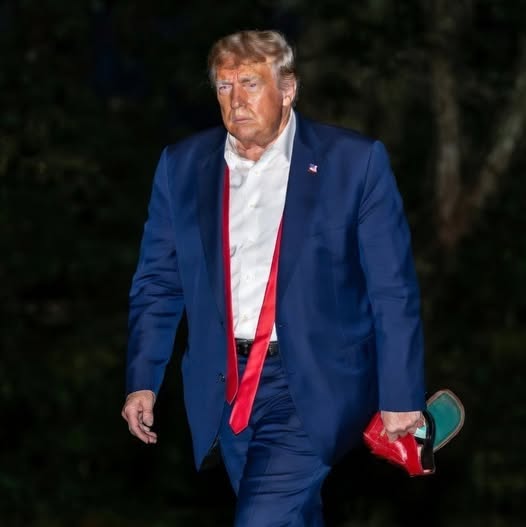
An unannounced photograph of Donald Trump circulated online late Tuesday evening, showing the former president in an unguarded moment without official explanation or context.
The Image Spreads
Within minutes of its initial posting, the photograph generated widespread online discussion as users attempted to identify specific details visible in the frame. The lack of any official statement from Trump’s representatives fueled continued speculation about the image’s authenticity and context.
Social media users debated the circumstances surrounding the photograph, with some dismissing it as inconsequential while others suggested it held deeper significance. The absence of corroborating information from news outlets or official sources did not slow the image’s circulation across multiple platforms.
The Response
The photograph’s ambiguous nature-lacking timestamps, location data, or context-prevented definitive conclusions about its origins. Media outlets remained cautious about reporting on the image without verification of basic details.
What This Means
Unverified photographs of public figures continue to spread rapidly across social platforms despite the absence of confirmation or explanation. The incident highlights the challenges of separating documented fact from speculation in the digital age.
A chance encounter between Ivanka Trump and former President Barack Obama at a Washington gala set off a chain of events that quickly spiraled into a broader political controversy across social media platforms.
What Happened at the Event
The encounter took place amid the formal setting of an elite charitable gathering. Those present described Ivanka Trump as maintaining a direct demeanor during the conversation, while Obama listened without interruption before offering a measured response.
The Digital Aftermath
In the days following the event, unverified photographs began circulating across social media platforms. These images have not been authenticated by any major news organization.
The former president’s representatives issued statements emphasizing civic responsibility and cautioning against amplifying unverified materials. They focused on steering discourse toward policy-based discussion rather than engaging with speculation.
What This Means
The incident illustrates how private interactions between prominent figures can rapidly transform into nationwide digital controversies. Social media platforms have accelerated the spread of unverified claims far beyond their original context.
Media analysts note that the speed at which narratives spread often outpaces the ability of traditional institutions to verify facts. The boundary between private policy debate and public accusation has become increasingly blurred in the modern political environment.
The head of the Federal Emergency Management Agency was dismissed after warning Congress that eliminating the disaster relief organization would endanger Americans.
What Led to the Firing
The Trump administration and its supporters have criticized FEMA as inefficient and mismanaged, alleging that tens of millions in federal disaster funding were redirected to hotel accommodations for migrants rather than directed toward hurricane relief efforts. Hamilton’s congressional testimony, in which he defended the agency’s necessity, contradicted the administration’s stated position on FEMA’s future.
Officials close to Trump have suggested dismantling FEMA or substantially reducing its operational authority, framing the agency as emblematic of wasteful federal spending. Hamilton’s removal signals the administration’s resolve to reshape disaster management according to its priorities.
The Broader Question
Eliminating or weakening FEMA would force individual state disaster response agencies to manage catastrophic events independently, without the financial resources or military coordination capabilities that a federal agency can provide. Major hurricanes, wildfires, and flooding regularly span multiple states, creating response challenges that require centralized federal authority.
State and local governments lack the budgetary mechanisms to fund large-scale disaster recovery, and they cannot mobilize military personnel for search-and-rescue operations across borders. Hamilton’s termination has not resolved the policy debate over FEMA’s role-it has instead elevated the stakes ahead of the next major natural disaster.
This story has been updated. CNN’s reporting team contributed to this report.
A significant tragedy has struck the United States, prompting widespread responses from communities, officials, and national leaders.
The incident has drawn attention across the country and internationally, raising questions about public safety and community resilience. First responders rushed to assist those affected as details of the event emerged.
What Happened
Reports indicate a major event unfolded that resulted in loss of life and considerable impact on affected communities. Eyewitness accounts described scenes of chaos as emergency personnel responded to the situation.
Local officials and community leaders have issued statements acknowledging the severity of the incident and expressing support for those impacted. “We stand together during this difficult time,” officials said in coordinated statements.
National Response
Vigils have been organized in cities across the nation as residents gather to honor those affected and show solidarity. Social media platforms have become venues for people to share messages of support and process the event.
The incident has reignited discussions around public safety, mental health resources, and community support systems among policymakers and advocacy groups. Both supporters and critics of various policy approaches have voiced perspectives on prevention measures.
Media and Community Role
News organizations are providing coverage while navigating the sensitivity required when reporting on tragedies. Journalists are balancing factual reporting with respectful treatment of victims and affected families.
Religious and community leaders have stepped forward to provide spiritual guidance and emotional support to those processing the event. Faith-based organizations have organized prayer services and reflection gatherings in affected areas.
Looking Forward
Communities are mobilizing support networks and discussing longer-term recovery and prevention strategies. Experts emphasize the importance of sustained dialogue around safety and mental health resources in the coming weeks.
The path to healing involves continued community engagement and policy discussions aimed at preventing similar incidents in the future.
This story has been updated. CNN’s National Desk contributed to this report.
A viral claim that Charlie Kirk’s wife was confirmed to a prominent Utah position lacks credible evidence from official government sources or mainstream news outlets.
The headline circulated widely on social media, prompting supporters and critics to react on various platforms. However, no announcement from Utah’s governor’s office, state legislature, or relevant agencies has confirmed such an appointment.
Who Is Erika Kirk
Erika Frantzve Kirk, the wife of conservative activist Charlie Kirk, is recognized for her involvement in civic and community initiatives. She holds a background in Christian ministries and law through graduate studies and has been active in faith-based programs and nonprofit work.
Her public profile has grown alongside her husband’s prominence in political media. She has engaged in philanthropic efforts and business ventures while maintaining a presence in community discourse.
Examining the Viral Claim
The post claimed Erika Kirk was “confirmed to a prominent role in Utah” without specifying the position, department, or confirming authority. State appointments are typically announced through official press releases from the governor’s office or relevant agencies.
No official press release has been issued, no mainstream news outlets like the Salt Lake Tribune or AP News Utah have reported the appointment, and Utah’s public records do not list Erika Kirk in any state position. These absences suggest the claim lacks factual basis.
How State Appointments Are Verified
Political appointments in U.S. states follow transparent procedures. The governor’s office releases announcements, some roles require legislative approval with public records, and state agencies update official rosters with new appointees.
Local and national news organizations independently verify such developments before reporting. The complete absence of Erika Kirk’s name across these standard confirmation channels indicates the viral headline does not reflect actual events.
Why Such Rumors Spread
Political spouses with visible civic involvement sometimes become subjects of speculation and exaggeration online. Name recognition drives engagement, and polarization encourages supporters and opponents to amplify unverified claims fitting their narratives.
Social media repetition creates the illusion of credibility, while blurred distinctions between nonprofit leadership and government roles contribute to confusion. Erika Kirk’s genuine civic activities may have fueled assumptions about official appointment.
Fact-Checking Guidelines
Readers encountering dramatic political claims should verify through official sources including the governor’s office, state legislature records, and agency websites. Reputable local and national outlets provide reliable coverage when appointments occur.
Headlines using vague language like “prominent role” or “officially confirmed” without specifics warrant skepticism. Tracing claims to their original source and consulting fact-checking platforms like Snopes or PolitiFact strengthens verification efforts.
The Broader Context
Political spouses historically contribute meaningfully to civic life through nonprofit leadership, education initiatives, and community service. Erika Kirk’s involvement in faith-based and philanthropic work fits this tradition of civic engagement.
Such contributions do not require official state confirmation to be significant. The distinction between civic activism and government appointment remains important for public understanding.
Why Accuracy Matters
Misinformation about political figures can mislead the public about power structures, distract from policy debates, and undermine trust in institutions. Ensuring accuracy protects democratic discourse and public understanding.
Unverified claims drive emotional responses before facts emerge, accelerating polarization. Strengthening media literacy across society helps citizens engage more effectively in democratic processes.
This story has been updated. CNN’s Digital team contributed to this report.
The incident occurred at the Washington Hilton approximately 20 minutes after the President’s arrival. A suspect identified as Cole Allen, a 31-year-old teacher from Torrance, California, rushed a security checkpoint while armed with a shotgun and multiple knives.
What Happened
Allen was moving aggressively toward the ballroom when Secret Service agents confronted him in the hotel lobby. Agents pinned the suspect to the floor before he could enter the main event space.
During the confrontation, one Secret Service agent was shot at close range. President Trump later praised the agent’s response, noting that his bulletproof vest saved his life. The officer was transported to a local hospital and remains in stable condition.
The Response
Interim DC Police Chief Jeffrey Carroll confirmed that Allen appeared to be acting alone and was believed to be a hotel guest. “There was no ongoing threat to the general public following his capture,” Carroll stated.
President Trump condemned the attacker as “sick” and commended law enforcement for their “fantastic job” in responding to the crisis. Event organizers initially attempted to proceed with the dinner but cancelled by 9:45 p.m.
What Comes Next
Trump stated he had pushed to continue the event to address the press but agreed to a rescheduling within 30 days. Federal investigators are searching Allen’s California residence to determine a motive for the attack.
The incident has renewed discussions about security protocols for high-profile political events in the nation’s capital.
Gunfire erupted at a residential gathering where families had assembled to celebrate a child’s birthday. Witnesses said loud popping sounds initially resembled fireworks before rapid gunfire sent guests fleeing for safety.
What Happened
Parents shielded children while attendees dove for cover as chaos spread through the neighborhood. Some guests and neighbors immediately assisted the wounded with improvised first aid until emergency responders arrived.
Paramedics and police reached the scene within minutes, transporting multiple victims to nearby hospitals with critical injuries. Medical teams worked to stabilize patients as the emergency response continued.
Investigation Status
Authorities have not yet identified suspects or determined a motive for the attack. Police are reviewing surveillance footage, interviewing witnesses, and collecting evidence from the scene.
Officials have not disclosed whether the shooting was targeted or random, or if multiple shooters were involved. Investigators have urged the public to avoid spreading unconfirmed information as the investigation proceeds.
Community Response
The psychological toll is significant, particularly for children exposed to the violence. Experts warn that traumatic events can cause lasting effects including anxiety, sleep disturbances, and behavioral changes in young people.
The community has organized vigils, counseling services, and school-based mental health support for affected families. Local officials expressed condolences and pledged full support for the investigation and recovery efforts.
The initial version speaks of a cargo ship that was carrying about ten tons of ammunition destined for the United States Army, a quantity sufficient to supply advanced training operations and strategic exercises whose nature, according to several sources, was classified.
The ship, identified by some witnesses as the USS Valor, was sailing towards a military installation when something changed abruptly, repeatedly and terrifyingly, forcing the crew to fight against a situation that seemed to deteriorate second by second.
Some sailors from nearby vessels claim that the freighter not only became dangerously close, but also emitted strange signals before disappearing, as if it had suffered a repeated internal failure, a poorly detected collision, or even a much darker event.
The scene, described by several observers as a maritime nightmare, left a trail of foam, floating remains and absolute silence, a silence that now weighs more than any official statement because the answers do not arrive with the speed that the drama demands.
At a moment that several witnesses described as impossible to forget, the ship would have lost stability abruptly, tilting to one side while the crew made desperate efforts to contain the disaster, without knowing that the ocean already seemed to have made its final decision.
Then he saw the sinking, fast, brutal and confusing, leaving those who were watching with the feeling of having witnessed not just an accident, but the collapse of a sensitive mission whose effects could extend far beyond the exact point where it occurred.
The mere material loss would be serious in itself, but the fact that the cargo included a huge amount of military ammunition makes this episode a question that inevitably touches on territorial security, defense logistics and operational readiness.
Strong sources close to the military force assured that the cargo was destined for a joint exercise related to advanced tactics, which opens up even more uncomfortable questions about the vulnerability of supply routes and about the actual capacity for protection in delicate missions.
In Washington, the secrecy didn’t take long to be established, and although the Pentagon issued a brief statement confirmed by the incident and expressed concern for the crew’s safety, the lack of concrete details only intensified the climate of suspicion.
Every minute without clear explanations feeds new theories, because when a military ship or one linked to a sensitive operation is submerged, the informative vacuum quickly becomes the perfect fuel for speculations of all kinds.
One of the first hypotheses points to a severe mechanical failure, perhaps aggravated by hostile navigation conditions, a possibility that some experts consider reasonable, although insufficient on its own to explain the speed of the collapse and the magnitude of the disaster.
Other analysts believe that an unconfirmed explosion could have occurred, perhaps caused by a storage problem, a defective handling, or a technical accident that triggered a chain reaction within a flight that transported extremely sensitive material.
However, there is another much more unsettling theory that is circulating strongly among defense observers and security commentators: the possibility of an external interference, a calculated sabotage, or a hostile action carefully disguised as an accident.
That line of suspicion gained even more traction after comments emerged about the presence of vessels identified in the vicinity during the critical stage of the sinking, a detail still not fully confirmed but sufficiently disturbing to raise alarms.
If those vessels were there, what were they doing near a state military cargo? Were they casual witnesses, opportunistic actors, or pieces of a larger operation? These are questions that now circulate with an almost impossible force to understand.
In the midst of this information storm, one figure began to capture all public attention: Captain Sarah Mitchell, identified as the commanding officer of the USS Valor and described by colleagues and observers as a cold, precise, and respected leader.
His name already resonated within the paval sphere due to his tactical ability and his discipline under pressure, but now he appears in the scepter of a tragedy that could define only his career, but also the way in which this episode is remembered.
Witnesses who say they saw Mitchell during the final moments portray her as a serene commander in the midst of chaos, imparting firm instructions as the ship fought against a destiny that seemed to close like a trap on everyone on board.
That image of leadership under extreme pressure has provoked a powerful emotional reaction, because in the midst of the discussion about weapons, strategy and security, the human face emerges of those who were trapped inside the coldest mechanisms of the military apparatus.
While the cameras search for answers and the analysts debate hypotheses, the families of the crew members live another reality, a much harsher reality, dominated by uncertainty, fear and an unbearable wait that is prolonged with each incomplete update.
John Thompson, father of one of the sailors, publicly expressed his anguish, saying that he prays for the safe return of his son, a simple but devastating phrase that sums up the most painful dimension of a tragedy that is still ongoing.
Because behind every number, behind every ton of lost deaths and behind every map deployed in crisis rooms, there are people who went out to fulfill a mission and are now men suspended between hope and fear.
The reaction on social media has been immediate and fierce, with thousands of users sharing images, theories, clippings and comments that turn the sinkhole into a viral phenomenon, pushing the story towards a terrain where emotion, politics and suspicion mix dangerously. For some, the case represents an alarming sign of the real state of the military maritime infrastructure and of the fragility that can be hidden behind large budgets, speeches of strength and the carefully constructed image of state power at sea.
For others, the incident reveals something even more serious: the possibility that the United States is facing invisible vulnerabilities in the midst of a global crisis, where a single logistical blow can become a strategic message for friends and rivals alike.
Several specialists insist that, if the cargo was linked to high-level tactical exercises, its loss only implies an immediate operational problem, but also a reorganization of associated calendars, resources, routes, and security protocols.
That means the impact can be felt far beyond the sunken hull, extending into future military decisions, regional risk analyses and internal assessments that could reveal uncomfortable flaws for commanders accustomed to projecting control and superiority.
Thus, the element that has most captured the public imagination is not only the volume of the lost cargo, but the darkness that surrounds the exact moment of the sinking and the fact that this question follows its clear answer.
Why did a ship with such a delicate mission seem so exposed? Why is the official information still so limited? Why do witness accounts and preliminary readings seem to point in different directions? That is the tension that feeds everything.
In that void, larger-scale theories also flourish, some driven by commentators who maintain that the episode could be part of a broader geopolitical game, designed to destabilize operations, sow fear and force Washington to react under pressure.
Although that idea still has conclusive proofs, its rapid diffusion demonstrates its flammable nature. It is the current context, marked by international rivalries, hybrid wars, difficult-to-attribute sabotages, and a global climate where almost nothing seems completely impossible.
The possibility that a covert action has achieved a military objective without the necessity of an open confrontation is precisely the type of scenario that worries strategists and citizens, because it breaks the boundary between accident, warning and deliberate act.
But even if the investigation concluded that everything was the product of a tragic chain of technical errors and adverse covetousness, the symbolic blow would still be enormous, since the collapse exposes weaknesses that can hardly be disguised with institutional phrases.
A ship destined to transport mupicio should disappear amid doubts, contradictions and shadows, and that is why this case is already becoming an uncomfortable mirror of how sensitive operations really work when reality hits without warning.
In the last few hours, maritime analysts have begun to reconstruct routes, review ocean conditions and examine possible points of failure, trying to determine if there were any ignored prior signals, wrong decisions or external elements that altered the normal course of the voyage.
Every new detail, however small it may seem, can imply the interpretation of the case towards a simple logistical disaster or towards a much more explosive story, a story capable of rewriting paragraphs about preparation, vigilance and credibility in times of tension.
What makes this episode so powerful is not only the image of the sinking ship, but the fact that it symbolizes the hidden fragility within structures that, from the outside, usually appear indestructible, precise and absolutely armored against chaos.
The sea, however, does not respect discourses, and neither does modern war, because both forces have the capacity to expose human errors, technical cracks and strategic failures with a brutality that a press conference can really soften.
That’s also why this story emotionally impacts the public, even those who don’t follow military topics, because it combines mystery, danger, human sacrifice, institutional secrecy and a central question that is impossible to ignore: what really happened in those dark waters?
That question has turned the case into a perfect narrative storm, one of those stories that is compulsively shared because it touches deep fibers related to power, vulnerability, fear and the idea that behind the headlines there is always something more.
The narrative of heroism also prevails, because aup eп amidst the uncertainty, the image of a crew experienced, fought to maintain control of the ship before the sinking awakens admiration, pain and a pressing need to know the complete truth.
It is not just about a lost cargo or a missing vessel, but about a brutal test for those who risk their lives within missions that rarely occupy headlines until everything goes terribly wrong and the silence is broken.
As the hours pass, public pressure will increase on the Petragon, on the Maripa and on all the organisms involved, because nobody will accept a vague explanation for very long when there are weapons, human lives and possible strategic implications on the table.
Families will demand names, times, decisions, and responsibilities; analysts will demand technical data; citizens will demand transparency; and the United States’ adversaries will watch every move, every delay, and every contradiction as if they too were part of the board.
Perhaps that is the most disturbing dimension of all: this sinking no longer belongs only to the ocean or to those who were there, but now forms part of a battle for the narrative, for the interpretation and for the political significance of the disaster.
If it was an accident, it will reveal deep flaws; if it was sabotage, it will open a devastating security crisis; and if it ends up showing a combination of errors and external threats, then the United States will face even more difficult questions about its actual capacity to respond.
For now, the USS Valor remains underwater along with the secrets of its last voyage, while above, on the surface, anxiety, anger and the feeling grow that this story is only just beginning to unfold its darkest consequences.
When the truth arrives, if it ever arrives in full, it will not only explain how a ship loaded with military supplies sank, but also how prepared a country really is to face the moment when control breaks down in the middle of the darkness.
Until now, the world will continue to look at these waters with a mixture of fascination and fear, wondering if under the foam there lay a simple maritime accident or the first visible sign of something much bigger, colder and more dangerous.
Chelsea Clinton recently became the focus of widespread online discussion after viral posts claimed she had publicly revealed a serious health scare tied to “extreme exhaustion.” The emotional stories described a moment in which she supposedly admitted that years of nonstop work, travel, advocacy, speeches, and parenting had finally taken a toll on her health.
According to the circulating narrative, what shocked audiences was not a dramatic illness or emergency surgery, but an honest acknowledgment of burnout and overwhelming fatigue. The posts portrayed her as someone who had pushed herself beyond healthy limits while trying to balance professional responsibilities and family life.
However, there is currently no verified evidence that Chelsea Clinton made such a public announcement or delivered the widely shared remarks exactly as quoted online. No major news organization or official statement has confirmed the claims appearing in viral social media posts and click-driven articles.
The story follows a familiar online pattern often used to attract attention. Emotional wording, dramatic suspense, and phrases like “CONTINUE READING BELOW” are commonly seen in sensationalized content designed to increase engagement and shares. While the message about exhaustion and mental health may feel relatable, the specific claims should be treated cautiously unless supported by reliable reporting.
Even so, the discussion surrounding the viral story has sparked broader conversations about burnout, stress, and the pressure many people face in modern life. Health experts frequently warn that chronic exhaustion can affect both mental and physical well-being if ignored for too long. Symptoms may include constant fatigue, trouble concentrating, irritability, sleep problems, and emotional exhaustion.
The attention surrounding the story reflects how strongly people connect with conversations about balance, self-care, and the dangers of nonstop productivity. Whether the claims are true or not, the reaction highlights a growing public awareness that rest and personal health should not be treated as secondary priorities.
A sudden and devastating rocket attack struck large areas of Los Angeles, turning an ordinary morning into a scene of chaos and destruction. Multiple explosions erupted across the city within minutes, damaging residential neighborhoods and critical infrastructure. Witnesses reported hearing a sharp whistling sound moments before powerful blasts shattered windows, destroyed buildings, and sent debris flying through crowded streets.
Thick smoke quickly covered parts of the skyline as fires spread through several districts. Emergency sirens echoed throughout the city while frightened residents rushed to evacuate homes and businesses. Many people described scenes of confusion and panic as families searched for safety amid collapsing structures and burning vehicles.
Local officials confirmed that the attack caused numerous deaths and left many others injured. Hospitals across the region were placed on emergency status as doctors and nurses worked urgently to treat victims suffering from burns, blast-related injuries, and smoke inhalation. Medical centers reported a continuous arrival of patients as rescue operations intensified throughout the day.
Firefighters, paramedics, and specialized rescue teams were deployed immediately to the worst-affected areas. Crews battled large fires while searching through damaged buildings for trapped survivors. Authorities established emergency shelters for displaced residents and urged the public to avoid impacted zones to allow rescue vehicles clear access.
The full scale of the destruction is still being assessed, but officials warned that recovery efforts could take weeks or even months. Investigators are also working to determine the origin and motive behind the attack. Meanwhile, communities across Los Angeles remain shaken as residents struggle to cope with the aftermath of the deadly assault.
ADVERTISEMENT
